
Healthcare – The Ultimate Vertical Market (Part 1)
Tidemark's Christian Kurth and Brendan Keeler join forces to unpack what makes the healthcare vertical so unique...sharing some "Epic" Vertical SaaS lessons along the way.


“I’m not a doctor, but I play one on TV.” This phrase, remembered from TV commercials in the 70s and 80s, describes how I often feel studying and investing in the massive and complicated healthcare market. It’s a $5 trillion marketplace that accounts for nearly 20 percent of U.S. GDP. Untangling its vast ecosystem of providers, payers, patients, and regulators, each with their own systems, incentives, and pain points, often seems overwhelming.
It’s also a rare end market that, like it or not, every American interacts with. As consumers, we’ve all witnessed its scale and complexity up close when a doctor we like is booked out four months in advance, or we receive an indecipherable “Explanation of Benefits” from an insurer, or find ourselves faxing — yes, faxing a form to a provider.
At Tidemark, we’ve built our firm around the thesis that software can transform certain verticals. We also believe that vertical markets share common characteristics that demand purpose-built software (our Vertical SaaS Knowledge Project (VSKP) provides an in-depth exploration of the subject). In this three-part essay, we will explore these themes further and make the case that healthcare is, in fact, the Ultimate Vertical Market.
This claim is based on a simple observation: healthcare takes the defining traits of vertical markets and pushes each to the extreme: deeper workflows, more fragmented and sensitive data, stricter and more complex regulation, and a larger, more divided set of stakeholders than almost any other industry. Four characteristics stand out:
- The existence of countless specialized workflows that remain largely under-automated.
- The abundance of extremely sensitive, unstructured, and fragmented data.
- A regulatory landscape that is unique, complex, and constantly evolving.
- The presence of multiple stakeholders with competing priorities trying to coexist.
Before diving in, I want to introduce my co-author and friend, Brendan Keeler, AKA the Health API Guy. Brendan is one of the sharpest minds in health tech, and I consider his blog/Substack newsletter required reading. I couldn’t ask for a better partner to explore how Tidemark’s Vertical SaaS framework applies to healthcare and what founders can learn from it.
Before expanding on the vertical market themes highlighted above, let’s start with the basics. The VSKP Frameworks underpin our investment thesis for Vertical SaaS and illustrates how enduring and spectacular Vertical SaaS companies can be. If you’re new to it, here’s a quick overview:
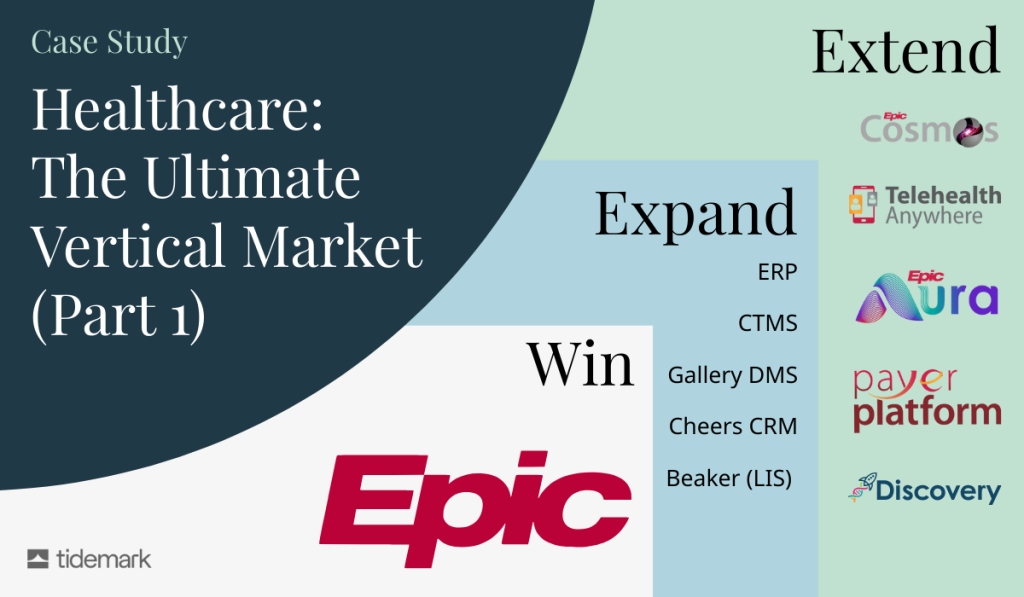
- Win The Category: Occupy the Control Point. The Control Point is the most important system, the last to be thrown out before an enterprise / business owner / merchant ceases operations.
- Expand Offerings: Go Multi-Product. Once you see a horizon where location growth will decelerate, grow Average Revenue Per Account (ARPA), and develop multiple integrated products.
- Extend Through the Value Chain. Extend offerings to key stakeholders throughout the value chain.
Epic: A Case Study on Tidemark’s Vertical SaaS Framework
Any deep dive into healthcare simply has to begin with Epic, which has become the standard all health tech companies aim to follow. And for our purposes, it’s one of the best examples of the VSKP framework in action. Few companies have successfully executed all steps of the framework in any industry. Epic has succeeded through disciplined dedication to product excellence and long-term decision-making. But it has also benefited from some of the four characteristics unique to healthcare that we described above.
The Epic story is not one of explosive growth from the start. Founded in 1979, it trailed other EHR players for more than 30 years. Yet its slow, methodical approach exemplifies the power of patient execution in vertical markets. Where its competitors chased quick wins and market buzz, Epic quietly built what would grow into the industry’s dominant platform.
Step 1: Win the Category – Occupy the Control Point
Epic’s dominance as healthcare’s control point didn’t happen overnight. For years, it focused narrowly on the most complex and influential organizations, large Integrated Delivery Networks (IDNs) and Academic Medical Centers. That approach paid off: Epic now holds 48% market share among large hospitals, far ahead of Oracle Health (27%) and Meditech (15%). Even more telling, Epic is said to have near-zero customer churn, meaning that any growth comes at a competitor’s expense.
In healthcare, the EHR is the ultimate control point. It houses critical patient data, governs daily clinical workflows, and increasingly influences care quality. The costs of switching, whether financial, operational, or clinical, are so high that once Epic is in, it’s nearly impossible to displace.
After locking down the large IDNs, Epic systematically expanded across entire health systems, displacing rival EHRs through the promise of a single, integrated platform. It benefited from overall industry trends: increased regulatory compliance burdens from HITECH and HIPAA, financial pressures requiring greater scale to negotiate with insurers, and the need for standardized clinical protocols across facilities. As providers consolidated, Epic didn’t just ride the wave; it helped create it.
Step 2: Expand Offerings – Go Multi-Product
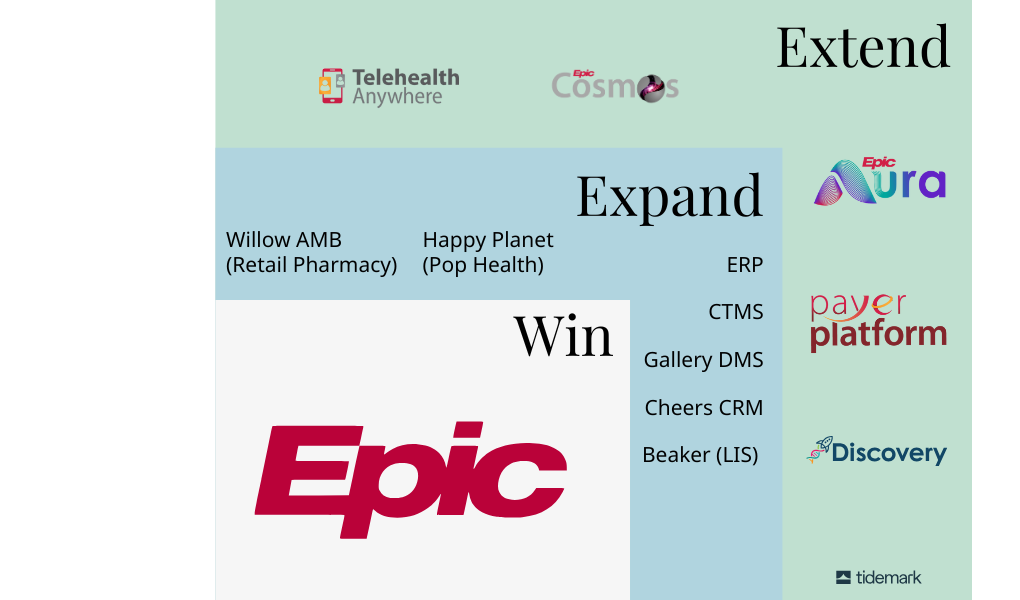
As we’ve laid out in the VSKP, control points have an unfair advantage when cross-selling and upselling. Epic has taken that principle to the extreme. Starting with its core EHR (EpicCare), it spent decades building a tightly integrated suite of tools that span every facet of healthcare delivery without a single acquisition. While competitors stitched together disparate products, Epic built everything on a single foundation.
Here are a few examples:
- HB/PB for revenue cycle and billing
- MyChart for patient engagement
- Willow for pharmacy
- Radiant for radiology
- Beaker for labs
- Healthy Planet for population health data
- OpTime for surgical management
All of these modules share the same backend, interface, and workflow DNA. This tight integration is Epic’s moat. Even when a competitor offers a sharper point solution, none can match the seamless handoffs that Epic enables. Picture a cancer patient moving from diagnosis to infusion to surgery to recovery, while every provider sees the same data in real time, with no gaps or duplications.
Epic’s “land and expand” strategy turns this product depth into a compounding advantage. Once a health system adopts the core EHR, layering on additional modules becomes the path of least resistance. Familiar interfaces, proven interoperability, and existing infrastructure make each new add-on more valuable, driving retention, revenue growth, and an ever-widening competitive moat.
Step 3: Extend Through the Value Chain
More recently, Epic has expanded beyond providers to serve payers, labs, life sciences companies, and others, systematically extending its reach to every major stakeholder in the healthcare ecosystem. This is the most advanced stage of the Vertical SaaS playbook: become the essential connector and infrastructure for the entire industry. The highlights include:
- Epic Payer Platform (EPP): Its most successful extension serves 32 major insurers, enabling real-time eligibility, automating prior authorization, and helping to close care gaps. The strategic play here is to solve insurers’ immediate need to access Epic provider data while positioning itself to replace their core systems.
- Cosmos: A massive de-identified dataset from nearly 300 million patients that creates numerous layers of network effects. Clinicians get decision support, researchers get population-scale data, and Epic gains an irreplaceable strategic asset. Careful governance, including an elected oversight council and rules that prevent commercial use, makes it a trusted infrastructure rather than a data product.
- Aura: Connects external labs and diagnostic centers to Epic’s provider network. Install it once and connect automatically to thousands of Epic sites. It’s a threat to lab integration middlemen while also providing a gateway to eventually adopt Epic’s Beaker LIS.
- Discovery: Supports clinical trial design and patient recruitment using data from Cosmos. Today’s trial recruitment tool could become tomorrow’s full clinical trial management system, challenging incumbents like Veeva.
It’s a clever strategy. Rather than aiming to replace incumbents in adjacent markets, Epic has made itself the essential connector, gradually increasing its gravitational pull across the healthcare ecosystem. The more stakeholders join its networks, the value of that network increases for everyone, making it progressively more difficult to operate outside of it. Meanwhile, the control points held by adjacent vertical players are slowly eroded away.
Specialized Workflows: When Sub-Verticals Become Industries
In order to truly understand why healthcare is the Ultimate Vertical Market, you have to start with a deep understanding of its workflows. They’re complex, deeply specialized, and as such require decades worth of domain expertise. As we’ve seen, Epic excels at automating a multitude of these jobs to be done in large hospitals. But what if I were to tell you that some of those workflows are too specialized even for Epic?
The healthcare sector is so massive that the areas Epic doesn’t serve represent enormous opportunities. Epic’s primary market is acute care hospitals, which accounted for about $1.5 trillion or about 31% of total healthcare spend in the U.S. as of 2023. Other major segments include: Allied Health (examples include physical therapy, mental health, massage therapy, etc.) at $100 billion, dental care at $160 billion, senior and long-term care at $400 billion, and veterinary care at $35 billion.
Each of these sub-verticals is large enough to dwarf entire industries that have already produced unicorn VSaaS companies. While Epic is vertical software relative to horizontal players like Salesforce or Oracle, within healthcare, it functions more like horizontal infrastructure. It’s built to meet the needs of large hospitals, but falls short in specialized contexts like dental or physical therapy, where the workflows, regulations, and business models are vastly different.
This dynamic creates massive opportunities for true sub-vertical specialists who understand that in many markets, depth beats breadth. It’s also the basis for a prediction: The next great SaaS company in healthcare will look nothing like Epic.
In Part II of this essay, we’ll explain why we feel so strongly about this. And we’ll introduce you to a Tidemark portfolio company that has built the operating system for SMB health and wellness practitioners, and how it’s winning by going all in on Allied Health.















Keep up with Tidemark
Sign up to receive new content as soon as it's released