
 Win
WinWhere Are The Opportunities in Vertical SaaS? Picking Your Market in 2025
With 2022 census data now available, Bob Solomon, Founder of Software Platform Consulting, shares an updated look at which verticals are ripe for a SaaS solution.

Where are the opportunities in Vertical SaaS?
A few years ago, Dave Yuan, Founder and Partner of Tidemark, and I wrote a blog post to shed some light on this common question we both receive: which verticals are ripe for a SaaS solution? Our approach was straightforward; we used census data to identify industries that are large and mostly made up of SMBs rather than big enterprises. The team at Omers Ventures expanded on this analysis.
The data for that analysis was obtained from the 2017 business census, and with the 2022 census data now available, it is a good time to update the analysis. (Also, I now have my data science-enthusiast nephew, Matthew, helping me do in minutes, with Python and ChatGPT, what used to take me hours a few years ago.)
Methodology
We conducted the same analysis as last time, but this time at the 6-digit NAICS level instead of the 4-digit level. (This is the most detailed level available.) Although this increases the complexity of the charts, we chose to do it for two reasons.
- Vertical SaaS has become much more specialized in recent years. It’s no longer enough to target trade contractors; roofers often now receive different solutions than electrical contractors.
- Matt’s automated process made it much easier to play with the data!
The Data
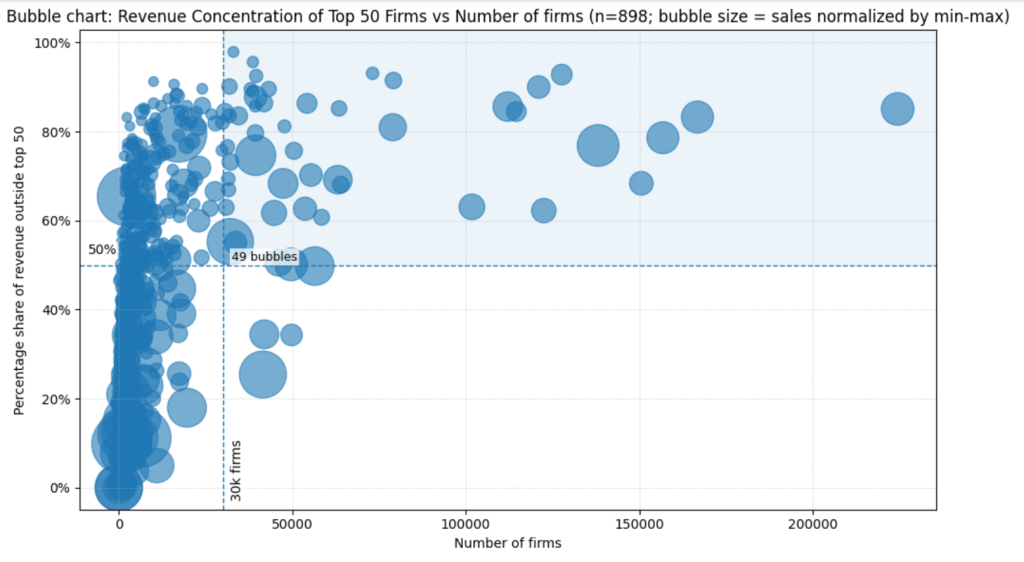
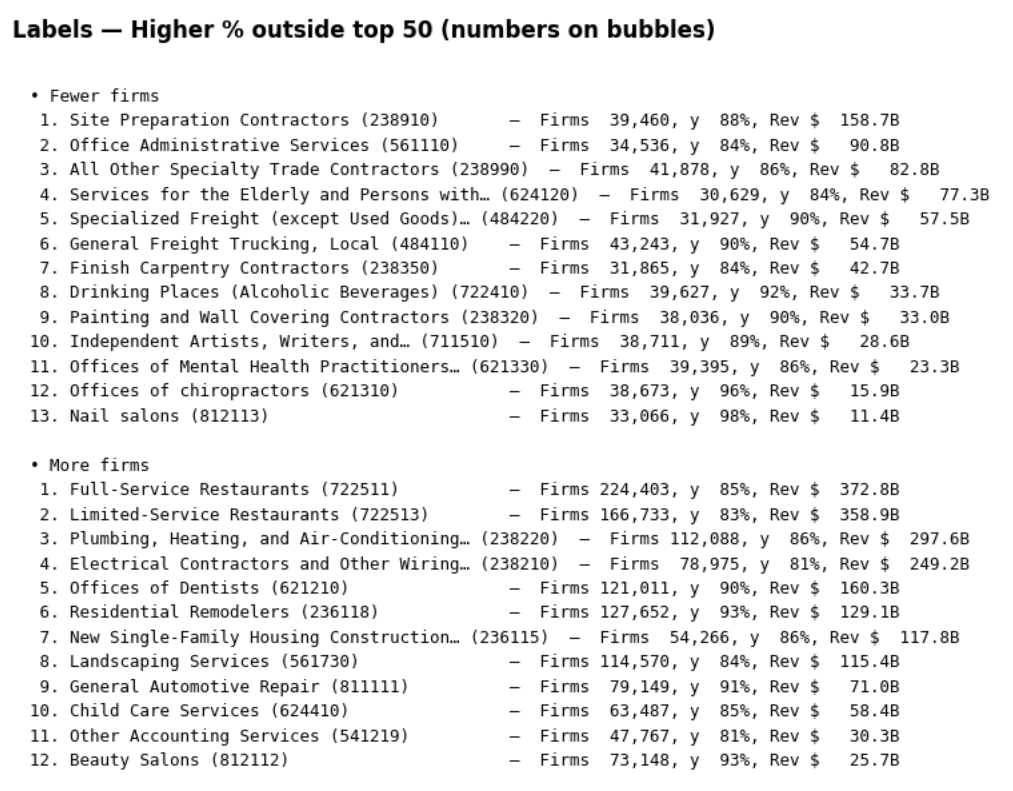
On the charts below, we aim to help you visualize the largest verticals with the most firms and the highest fragmentation.
Here’s how to read the charts:
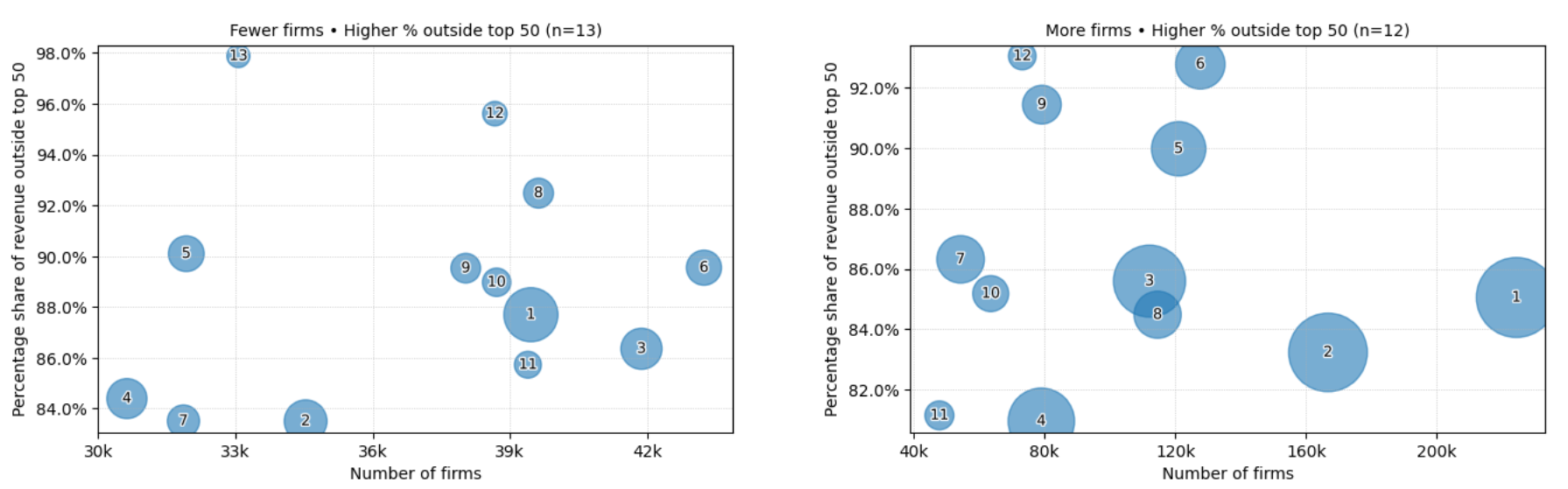
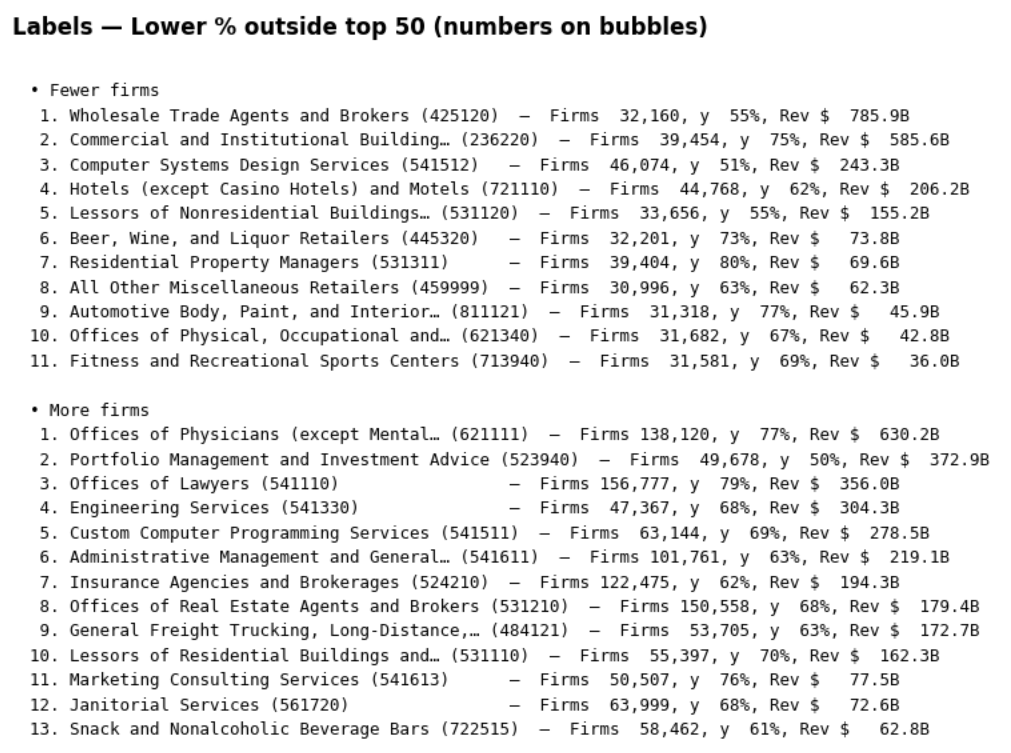
- Each circle represents one 6-digit NAICS code.
- A circle’s size is proportional to the sales of the industry.
- The x-axis represents the number of companies in each 6-digit NAICS industry.
- On the y-axis, you see the market share of all but the top 50 companies. So, for industries near 90% on the y-axis, the top 50 companies make up only 10% of the market (highly fragmented). Conversely, in industries near 50% on the y-axis, the top 50 companies account for nearly 50% of the revenue.
The first chart shows nearly 900 6-digit NAICS codes, but it’s too much data, as you can see.
To make the data easier to visualize and highlight the markets with the most firms and the highest fragmentation, we used two (somewhat arbitrary) filters. We show only those 6-digit sectors that have:
- More than 30,000 companies
- Market share of the top 50 companies is under 50%.
These are the 49 6-digit NAICS codes shown in the upper right quadrant of the first chart.
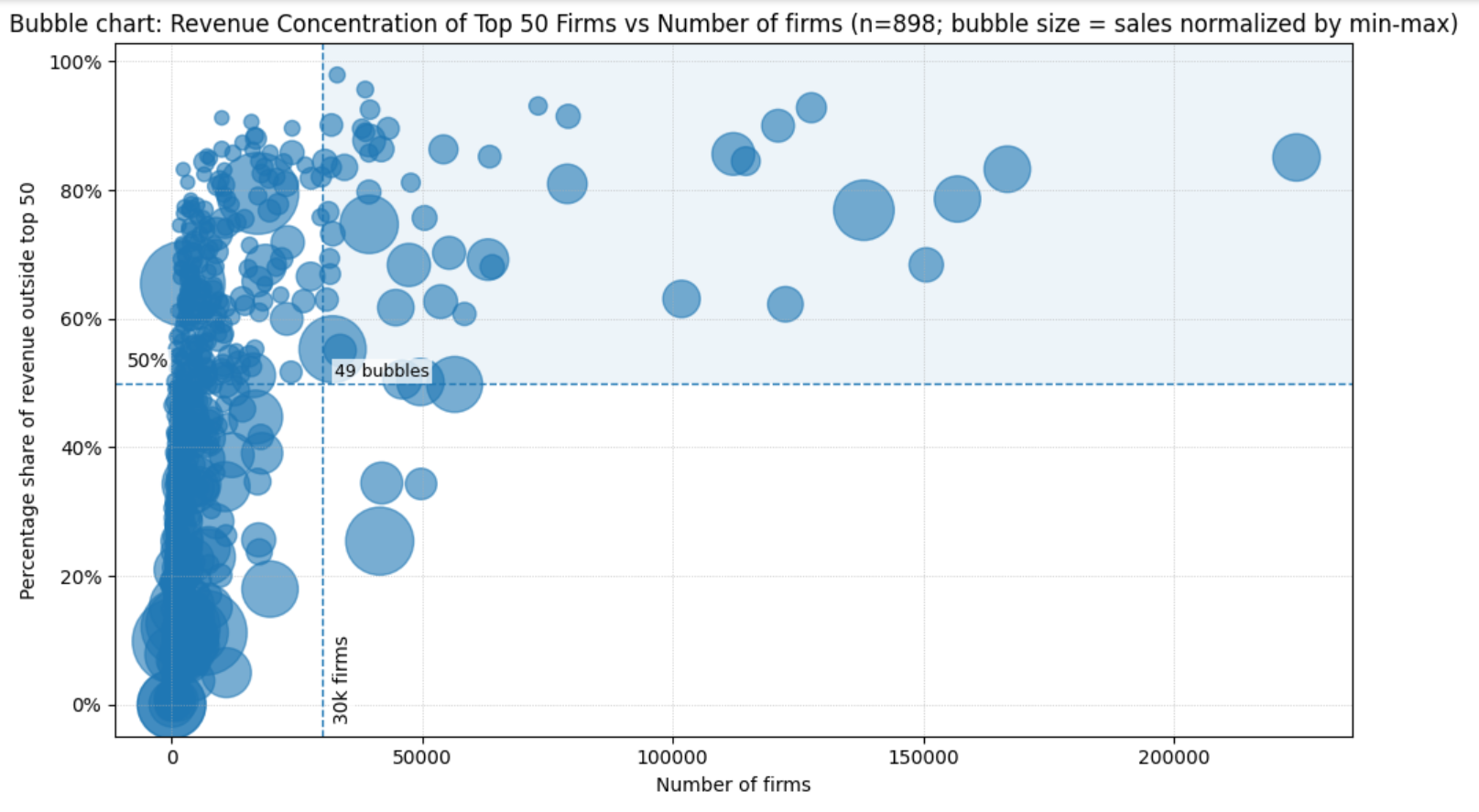
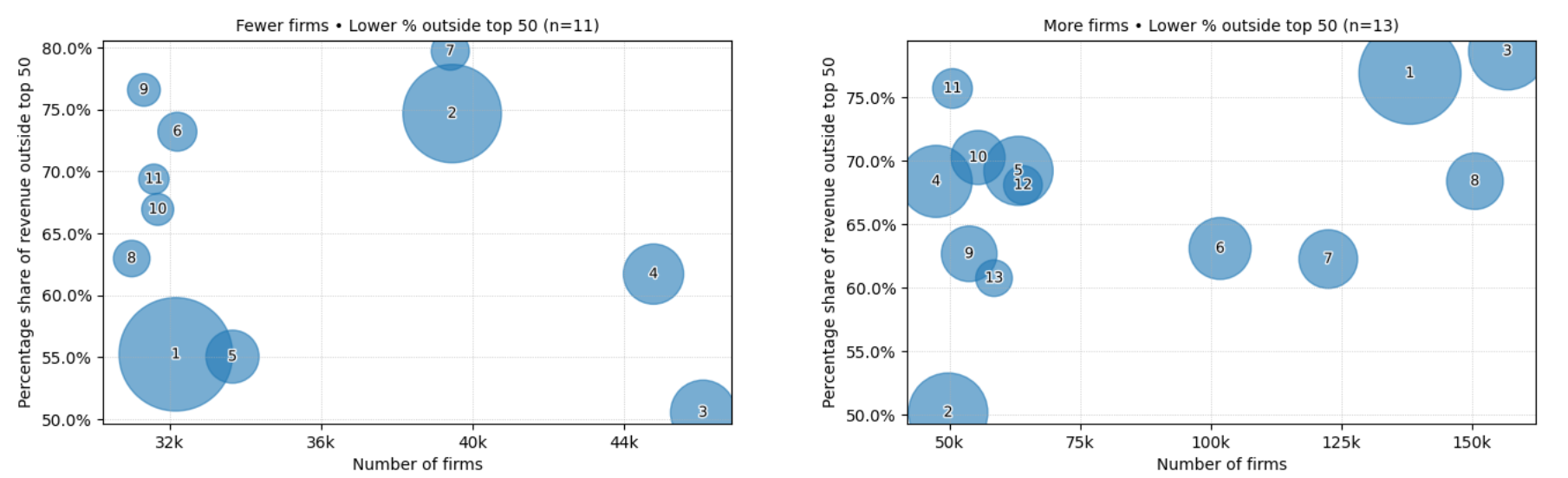
The subsequent four charts simply divide that upper right quadrant into four smaller quadrants for clarity.
Observations
- If you follow vertical SaaS companies at all, you can see that many of the great names in vertical SaaS align with some of the largest, most fragmented industries:
- Toast for restaurants
- ServiceTitan for contractors
- Dentrix and Eaglesoft for dentists
- Hyphen Solutions and Buildertrend for residential builders and remodelers
- This raises the logical next question: are all the great verticals already crowded with existing vertical SaaS players? I’m sorry, but that question is outside our current scope. It would be fascinating to compare the market cap of public companies for software companies, plus the capital invested (or valuation of private companies) in each six-digit NAICS vertical, to the industry revenue or number of firms in each vertical. This analysis would give us a sense of relative investment in each vertical versus industry size.
- Remember that this analysis only examined the industries in the top right quadrant, which was defined relatively arbitrarily at that time. In a future post, we will explore the top left quadrant, which features large industries with equivalent fragmentation to this quadrant, but with fewer companies. This simply means that vertical SaaS companies are selling more to mid-market companies than to SMBs, but there are still great businesses to be found there.
- Finally, great vertical SaaS companies are selling to highly concentrated industries, the lower left quadrant, but those are enterprise software companies, which is a different motion.
If you would like access to Matt’s code for manipulating the data, feel free to contact him on LinkedIn!









Keep up with Tidemark
Sign up to receive new content as soon as it's released