System of Action — Part 3: How Control Points Win

The Road to Control Point Badassery (Leadership & Product)

By Dave Yuan

Founder and Partner, Tidemark

You’re the CEO of an incumbent vertical SaaS Control Point. You’ve scaled locations, gone multi-product. Maybe you’ve even extended through the value chain selling into your customers’ suppliers, employees, or consumers. You’ve done everything right. 

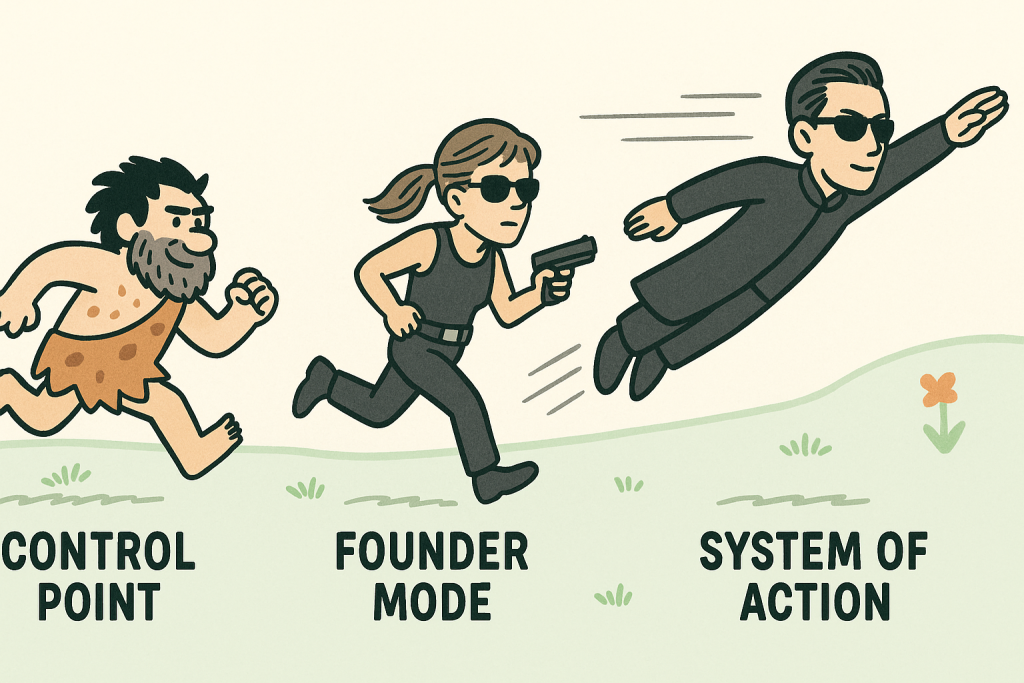
But now the Native AIs are coming for you. At this point, you may feel like Sarah Connor in The Terminator. Machines from the future, funded by relentless VC dollars, are coming to kill you.   

"It can't be bargained with. It can't be reasoned with. It doesn't feel pity, or remorse, or fear. And it absolutely will not stop... ever, until you are dead." - Kyle Reese, Baby Father of the Rebellion, Terminator

But, Sarah fights back. She not only survives, but leads a rebellion against the machines. She takes on the threat, gets super-ripped, and emerges as a complete badass. So can you.

This essay was written for you, Control Point CEO, to help guide you on your Road to AI Badassery

It’s a long one, so here’s a roadmap: We’ll start with a quick speedrun through our perspective on Vertical SaaS and AI. Then we’ll get into the meat of the argument. Steps 1 - 2 lay out organization focus, urgency and fortitude required to make the transition. Steps 3 - 4 cover the specific product management and infrastructure capabilities you need to win. Steps 5 - 8 provide frameworks for which agents to build. 

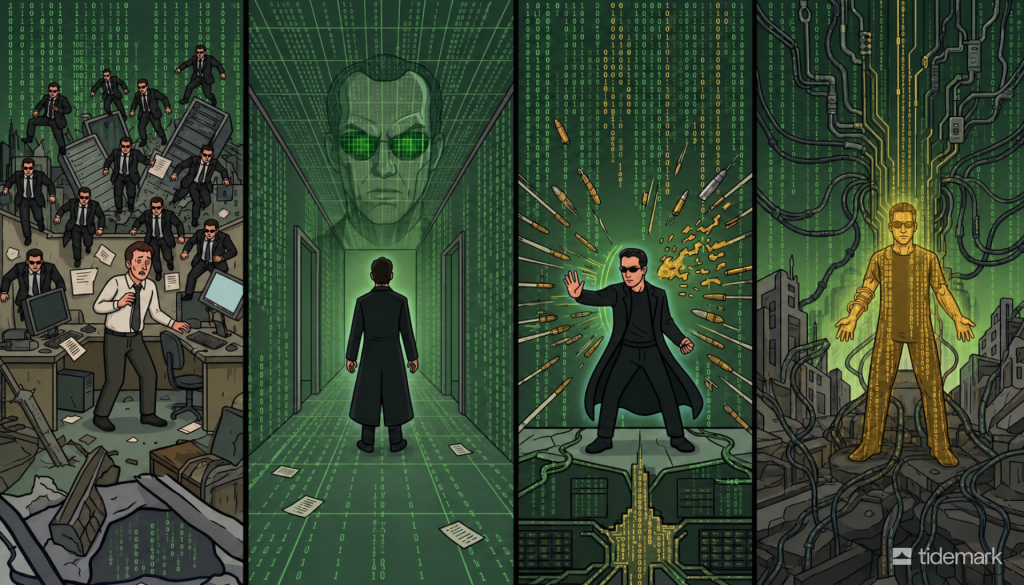
And because they’re the two best sci-fi franchises of all time, we’ll use The Terminator and The Matrix as narrative guides to your hero’s journey. I tried to rely on The Terminator alone, but both movies serve as perfect metaphors for what’s ahead, each capturing a different phase of the Control Point journey: surviving the initial attack and then mastering the new reality. So we’ll use both to chart your arc from defense to full-blown rebellion. 

This time: How Control Points Win. And next time: How Native AIs Win.

Let’s go!

The Theoretical Foundation

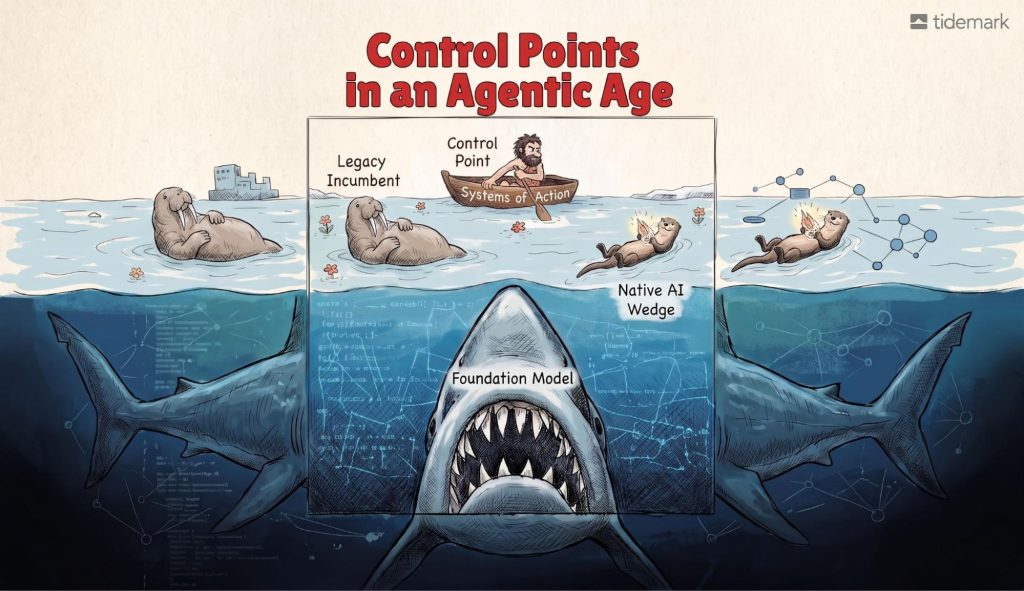
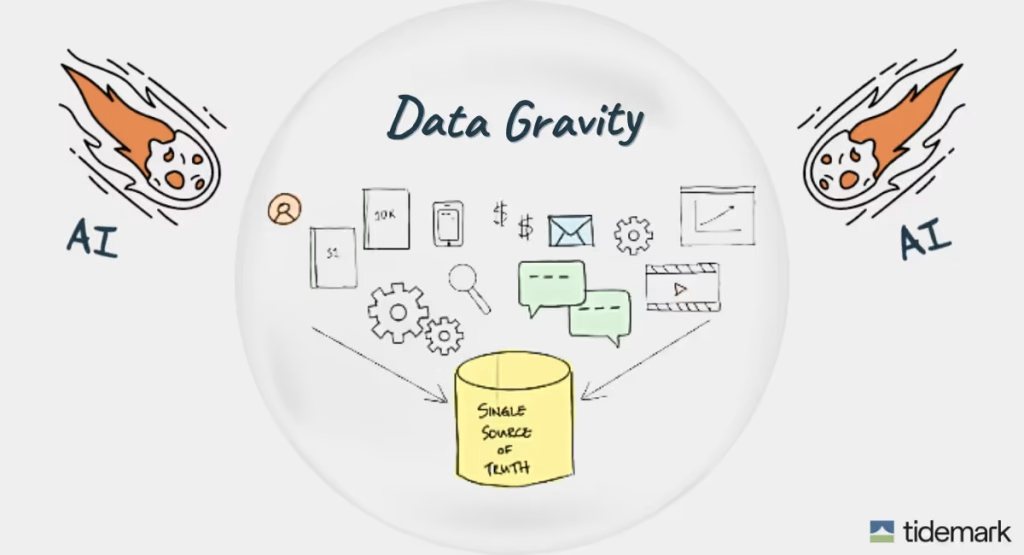
You can dig into our many preceding essays on vertical SaaS and AI, but the short version is this: Control Points, by virtue of their workflow and data gravity, enjoy an unfair right to sell multiple products to their customers — even to the point of becoming an "operating system" within their vertical. That remains true not only for traditional software products but also for new AI offerings. 

In 2023, we wrote, if Control Points aren’t asleep at the wheel, they can leverage the hundreds of billions poured into AI infrastructure to launch products that rival Native AI players. We still believe that. But that was nearly three years ago! And if you’re a vertical SaaS Control Point, you’re on the clock.

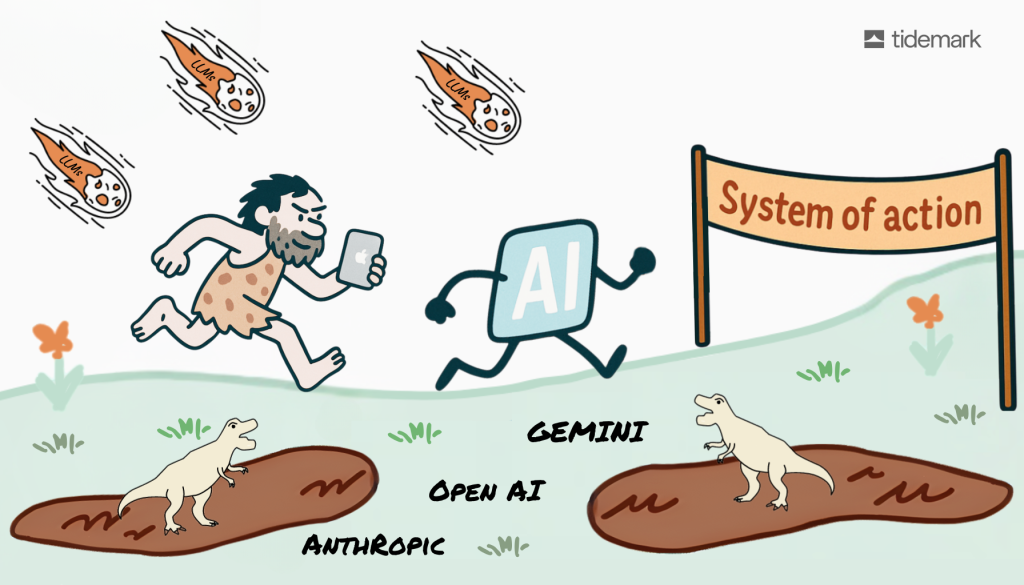
Native AI challengers are raising unprecedented amounts of capital, shipping product at blistering speed, and inserting themselves into the workflows and data flows that once defined your moat.

In Part 1, we laid out the first vector of attack: Hero User tools. Native AIs win when they target the hero doers — the lawyers drafting contracts, the mental health practitioners seeing patients — who have the agency to choose their own software tools. By giving these heroes tools that make their “good work” easier, while automating administrative work, Native AIs will win hearts and minds. And by making these tools easy to try, easy to buy and easy to use, (product-led growth), they will win adoption at alarming speed. These tools may appear flimsy at first, but once they integrate into Control Point workflows and data, then start triggering action, you’ve lost the high ground.

In Part 2, we showed what happens when there is no Hero user buyer. Native AIs then go after Sticky Jobs: the high priority, high hassle jobs that require communication, collaboration, and coordination. These are often handed to a “Cousin Richie,” — internal staffers, outsourced or offshore agencies, or not done at all. AI is a far better alternative. It works 24/7, in multiple languages and always works towards your goals. By taking over these sticky problems, Native AIs wedge their way to the business owner. And that wedge leads, again, to integration, expansion, and eventual displacement of the incumbent Control Point.

Parts 1 and 2 are how Native AIs attack. Part 3 is for you, Control Point founder. It’s about how you fight back, and how you win.

The Road to Control Point Badassery…

Sarah Connor gets her founder vibe on...

1. Embrace Founder Mode

Sarah Connor went from victim to warrior by accepting an uncomfortable truth: an unrelenting machine from the future was trying to kill her.

Sarah Connor: “They cannot make things like that yet.” Kyle Reese: “Not yet… not for about 40 years

If you’re the CEO of an incumbent — especially a successful incumbent — you need to set the tone and sense of urgency across the organization. No one else can.

You can’t delegate this by hiring a “head of AI” (most of this is too new and anyone proven in the space is likely out of reach unless you’re Zuck). And while your board is pushing you to “get more AI,” remember: AI is not an end in itself. It’s a technology for solving customer problems. 

As the CEO, you must lead from the front: You don’t need to be training models yourself, but you do need to know how to separate the hype from reality, and how to connect AI to customer needs and company strategy. You also need to get your team to understand that the world is changing very quickly and that it is unacceptable for your company not to change the way it works. Tobi Lütke of Shopify is a good example of this approach. 

And you need L1s who push you in the right direction. If your product and engineering leaders aren’t raising your comfort level with AI, you need different leaders.

2. Get Fundamentally (AI) Strong

Catching up on AI will require investment. Even the giants — Microsoft, Meta, and Amazon — cut costs to free up billions for AI reinvestment. You’ll have to create a similar buffer.This isn’t just about efficiency; it’s about freeing resources to move at the pace AI demands.

AI tooling in operations can drive efficiency, but only if there’s top down leadership not idle speculation. I spent some time with Jellyfish (a software company that works with over 500 software product and engineering organizations) to understand the impact of AI in mid market and public software companies. Jellyfish’s CEO Lau said in September 2025 that about two-thirds of their customers are using AI tools in engineering which is good. But they are only seeing a 35 percent increase in throughput.  

Thirty-five percent isn’t bad, but it’s a yawn compared to the efficiency Native AI companies are achieving. You can explore more via Henry Shi’s LeanAI Leaderboard

The gap? Adoption! The full results of our study with Jellyfish, reinforce the point: the barrier isn’t technology or tool choice, it’s behavior change. The TLDR: it’s not technology or tool choices, it’s behavioral change. Bottom-up adoption and carrots can help, but what really drives progress is top-down accountability. Again, crazy founder mode.

3. Raise Your Product Management Game

Okay, you have more resources, so go build AI! That path leads to lots of spending, some great slides, maybe even demos, but probably little revenue. AI is not a product. It is a set of technologies. It’s software! So what are you going to build?  

The answer starts with thoughtful, prioritized and focused product roadmaps and clear, urgent deadlines. That’s traditional product management. What’s new is the pace and the technological frontier. Native AI competitors ship in weeks; many traditional SaaS companies ship in quarters or years. Product velocity is the difference. You need to step up your timelines. At the same time, AI is continuously redefining what’s possible. We covered some of the specifics in SOA 2, but the mandate is clear: reimagine workflows and tasks with these emerging capabilities. 

You also need to know your customers cold — not just how their businesses run, but how the work actually gets done. Your stakeholders also expand from the owners who sign contracts, to the practitioners who actually do the work. Map the key personas, their key workflows (formal and informal) and the systems they rely on. 

“To me this is also about pushing your team to get way closer to your customers. In order to do the work, you need to gain proximity to the work in a way that you never had to before. It's a completely different game for PMs.” - Jack Newton, Co-founder and CEO of Clio

This shift also demands changes in how the company works. The old cadence — quarterly product requirement documents, and development cycles that last months — won’t cut it. Kill the PRD. Replace long requirement documents with prototypes. Get comfortable shipping, testing, and iterating at AI-native speed.

“When we saw how valuable AI would be for our customers, we essentially refounded the entire company around that mission: Automate human labor with AI…Talk to customers, build product, repeat. Our obsession with speed and customers has increased product output by 3x.” - Eric Rea, CEO of Podium

Perhaps most important — and most difficult: If you are going to add agentic solutions to your product portfolio, you need to make space for them. That means killing other projects. Pet projects are easy to cut; the harder calls will involve some uncomfortable tradeoffs and likely some team turnover. For successful, fat-and-happy incumbents, this is doubly hard. You probably were a bit sloppy to begin with, but board mandates to “add AI” may only extend the culture of “and.” 

4. Build to Your Strengths

In SOA1 circa February 2025, we exhorted Control Points, “don’t let great get in the way of the good!” It’s early – just ship point solutions that serve customer needs even if they aren’t integrated into your core systems. The goal is to delight users, not win Nobel prizes.

As of October 2025 that remains true — particularly with hero user tools. Just ship! Go build, get your products into market!  

However, in parallel, you should start building the infrastructure that will scale with the agentic future and align with your existing strengths. 

Expose Your Full Functionality — Agents as First Class Users

As the Control Point, you likely manage the most important workflows and the most critical data.  That’s a wealth of opportunity for agentic automation.  

Let your agents access all your product’s functionality. Some have suggested using your current UI as an integration layer for agents; others argue for more comprehensive product rewrite. Either way, build a roadmap to ensure your agent users can engage with everything that human users can.

Build for Non-Human Triggers

Don’t limit your inputs to human prompts. Let events, other agents, and humans all trigger agents. (h/t Harrison Chase, Langchain, AIAscent)

Embed Into Existing Workflows

MIT recently studied the 95 percent failure rate of AI in the enterprise, and found that AI pilots failed because they weren't embedded in day-to-day workflows. They were the islands of functionality that users had to actively seek out, requiring behavior change. (h/t Jack Newton

“For organizations currently trapped on the wrong side, the path forward is clear: … start partnering with vendors who offer custom systems, and focus on workflow integration over flashy demos.” - The GenAI Divide State of AI in Business 2025

As the Control Point, you own the most important workflows. You have an incredible advantage to embed AI into existing workflows, or to extend them further.

UIs for Trust

Andrej Karpathy argues that humans need tools they can trust. (See video.) That means UIs that let users understand and control how much automation is applied depending on comfort and context. 

As the Control Point, users are in your systems every day, all day. They may not always love your UI, but they are familiar with it and trust it. Build co-pilot experiences that reinforce that trust and are integrated into your UIs, not as a standalone chatbot on the side. 

Build for Humans-in-the-Loop 

One of your biggest opportunities you have as an incumbent is your ability to provide human-in-the-loop verification (h/t Nick Mehta).  Make it easy for a human user to quickly inspect the AI’s results, understand why the AI came to the results, and correct the AI’s results if necessary. Making this process easy and transparent within a user’s workflow builds trust. 

Build for Humans-in-the-Loop at Scale

Double down on this strength by scaling human-in-the-loop processes across your customer base.  

“We had to give owners the tools to customize and control their AI agents like they manage their teams - through policies, approval workflows, and real-time interventions. This level of 100% customization and control creates customers who expand usage instead of saying ‘AI isn’t ready’.” -Eric Rea, CEO of Podium

To do this, form a clear and specific opinion about where human-in-the-loops input is required:  Some of the common human-in-the-loop workflows we see are:

  • Escalate/ Assign: route high priority or high stakes customers/jobs to specific roles or queues (finance manager, senior rep, store GM) with full context 
  • Approve: commit AI proposals — discounts, credit steps, offer terms, appt times — with a single or batch click
  • Reject: block or replace proposals; capture the reasons as structured feedback
  • Edit: quick in-line redlines to copy or offers; feed the differences automatically fed to Trainer Agent
  • Answer: supply missing facts (VIN, stock, eligibility) without taking over the thread
  • Time travel: jump across timeline; revert to prior state and continue
  • Manage, route and resolve exceptions and edge cases

(h/t: Harrison Chase, LangChain, AI Ascent)

Build for Learning 

The corollary to human-in-the-loop verification is learning and training. How do you make sure your agents serve your 100th customer better than the 90th? Invest in objective metrics that measure not only outcomes, but also the quality of the outcomes.  

Capture Engagement and Informal Context

So much work isn’t documented. It lives in the informal context, sub-workflows that rely on human knowledge and judgment. Build toward consumer-grade engagement. If users are in your product every day, you have a chance to see what they are doing, learn from them, and propose helpful automations and agents. (No wonder why there’s been an acquisition run on browsers companies.)

Become the Orchestrator

In many situations (e.g with practice management), you can see the whole job and break it into subtasks. Assign them to humans, third parties, and increasingly to agents. Modernize task management to assign work to agents with the right context, authentication, and human-in-the-loop checkpoints. There’s also an opportunity to create standards for agents to collaborate with other agents to improve the accuracy and efficiency of communications. The entire workflow may not reside in your software, but that’s your opportunity to become the orchestrator.

(I’m biased, but our portfolio company Karbon has way out front on this orchestration! See video.)

What to Build

Now comes the fun part: deciding what to build. There are endless ways to extend workflows, remove friction, reduce hassle, and capture new revenue. But customers have finite capacity to consider new offerings, and your team has finite capacity. If you feel over-eager at the agentic buffet, go back and re-read step 3 — traditional product management — that’s your north star. 

That said, here are some of patterns we’re seeing:

5. Agents that Do the Work (SOA1 & SOA2)

AI is bringing new capacities to actually do the work, rather than just tools to run the business. As a result, we’re seeing both opportunities and threats emerge in “Hero User tools,” and “Cousin Richie problems” as described in SOA1 and SOA2. You can go deep on both pieces, but here’s a quick synopsis: 

  • Hero User Tools: Does your customer have a Hero User that has the agency to buy their own tools?  If so, read SOA1 and make tools that make that hero’s life magical…  
  • The Good Work: This is what a customer prides themselves on doing and it’s the reason they exist. Often the people who do it are the most celebrated. For accountants or lawyers, it’s advising clients. For a medical professional, it’s delivering care. Empower the Hero Users with co-pilots that make their work easier and more effective.
  • Administrative Work: The work you have to do that no one loves — scheduling, reconciling, invoicing. You want to do it as quickly as possible and often poorly. Make the Hero User’s life easier, by taking it off their plate — automate it away. Give your Hero Users time back to do the good work.
  • Work Not Done: This is valuable work that doesn’t get done — either because there’s no time, skills, context, or resources. It often gets outsourced or ignored, even if it’s valuable. Examples include: Picking up the phone during lunch hour, filing compliance statements, running multiple bids ensure the lowest cost. Build AI to take on this work and your customers will wonder how they ever lived without you. (Read “Race to System of Action Part 1: “Hero User Tools”.)
  • Important Work Not Done or Done by Others / Cousin Richie: Running a business is hard. There’s always plenty of important work leaders know they should do but can’t find time for. So they delegate it to their “Cousin Richie,” outsource it locally or overseas, or worse, skip it entirely. Build AI to do those jobs for your customer and they will love you forever. (Read a much longer write up on “Cousin Richie Problems here.)

6. Agents that Do Multi-Stakeholder Jobs

Communicating with external stakeholders is a grind. Much of the world still communicates via phone and fax. Even email can be a hassle of endless back-and-forth strings with documents and images attached. AI shines by digitizing this analog chaos, interpreting and creating structure, and enabling more automated collaboration. 

We believe the next generation Native AIs will try to wedge themselves between you and your external stakeholders. They will build agents on your “power lines” (h/t John Foreman) — the platforms that carry the most important workflows, house the most critical data, and dominate customer mindshare. Think about the systems that control how money flows, how inventory gets allocated, how employees are coordinated, and how customers and suppliers communicate. 

Even worse, they’ll try to get in front of you on dollar inflows or key formation workflows. With the first one that means lead and order management or rebates. With the second, think of processes like permitting and estimating. If you let Native AI players build a foothold here, they control the action. Be wary of integrating with them in these areas. Build your own competing offerings to box them out and defend your Control Point. 

7. Agents that Bring in $

There is no faster way to a business owner’s heart — or wallet — than to bring in customers, sales, and cash. We covered this in the past in consumer extensions, but agents offer new technological ways to make this happen.

Agents can reimagine every part of the funnel: smarter marketing, demos and information sharing, customer qualification, appointment setting and lead management, loyalty promotions, and price optimization. 

And it’s not just customers. Agents can also bring in cash from external stakeholders like suppliers, lenders, third party payers, and even government bodies.

8. M&A

If you have the financial scale, M&A can be a powerful product lever. Consider it when:

  • The industry is moving faster than your product organization.
  • You need capabilities you’re unlikely to build. Example: hybrid consumer-AI led + practitioner care; If you’re a dyed-in-the wool enterprise, consumer-grade magic is hard to create.
  • You can meaningfully consolidate the industry.


M&A always comes with massive considerations, and these motivations are not unique to AI. But AI’s speed and the far reaching implications of its impact make acquisitions an option worth  considering sooner rather than later.

The Future…

If you’ve made this far and successfully launched and scaled agentic solutions, congratulations you’ve flipped the “AI killing SaaS” narrative.

This isn’t hypothetical. We’re already seeing Control Points fight back. The early results are compelling: 2–5x uplift in ARPU without cannibalization, and in some cases 10x when agents take on work that was previously outsourced.

We’re also seeing a new phenomenon: Control Points selling agents on top of rival Control Points. A company that once defined itself as a SaaS platform is now packaging agents as an “integrate and surround” play against competitors. The line between incumbent and challenger is blurring fast.

You’ve put Native AIs and rival Control Points on notice. The hunted is now the hunter. You’re coming for them.

8. Build the Matrix

If you’ve captured the strategic high ground and built a platform to scale, now it’s time to play to win. Build the matrix! 

Create a network of agents that do the work, add value in the most critical jobs, win the hearts and minds of your customers’ key personas. This is the Value Roadmap, (see SOA2), a plan to expand jobs and personas within each customer over time.

Final Thoughts

In the end, the race to become the System of Action isn’t really about SaaS or AI. It’s about what software runs the business and does the work. That’s a huge prize, one that dwarfs Vertical SaaS alone. 

Vertical SaaS Control Points incumbents have every right to claim that prize. But it will take CEOs and founders who are willing to get uncomfortable, get fit, and become the Sarah Connor badass that we know they can be. 

Today’s discussion focused on organizational leadership, alignment and product strategy. Next we’ll tackle go-to-market and pricing.

Then, we’ll take the blue pill, and come back with an essay on “How Native AIs Win.”