
 The Long View
Building the Industry Ledger in Construction with Chase Gilbert, CEO, Built
At the 2025 VSaaS Collective Live on November 5, Chase Gilbert walked through what it actually takes to change a fragmented industry like construction. His session made a blunt case for starting with the real leverage point — the flow of money — and building outward from there. What followed wasn’t theory, but the eight-year process behind turning construction finance into a functioning industry ledger.

Chase Gilbert’s talk was the closest thing the day offered to a practical field guide for building an industry ledger — and a reminder that you have to start with the money, not the UI.
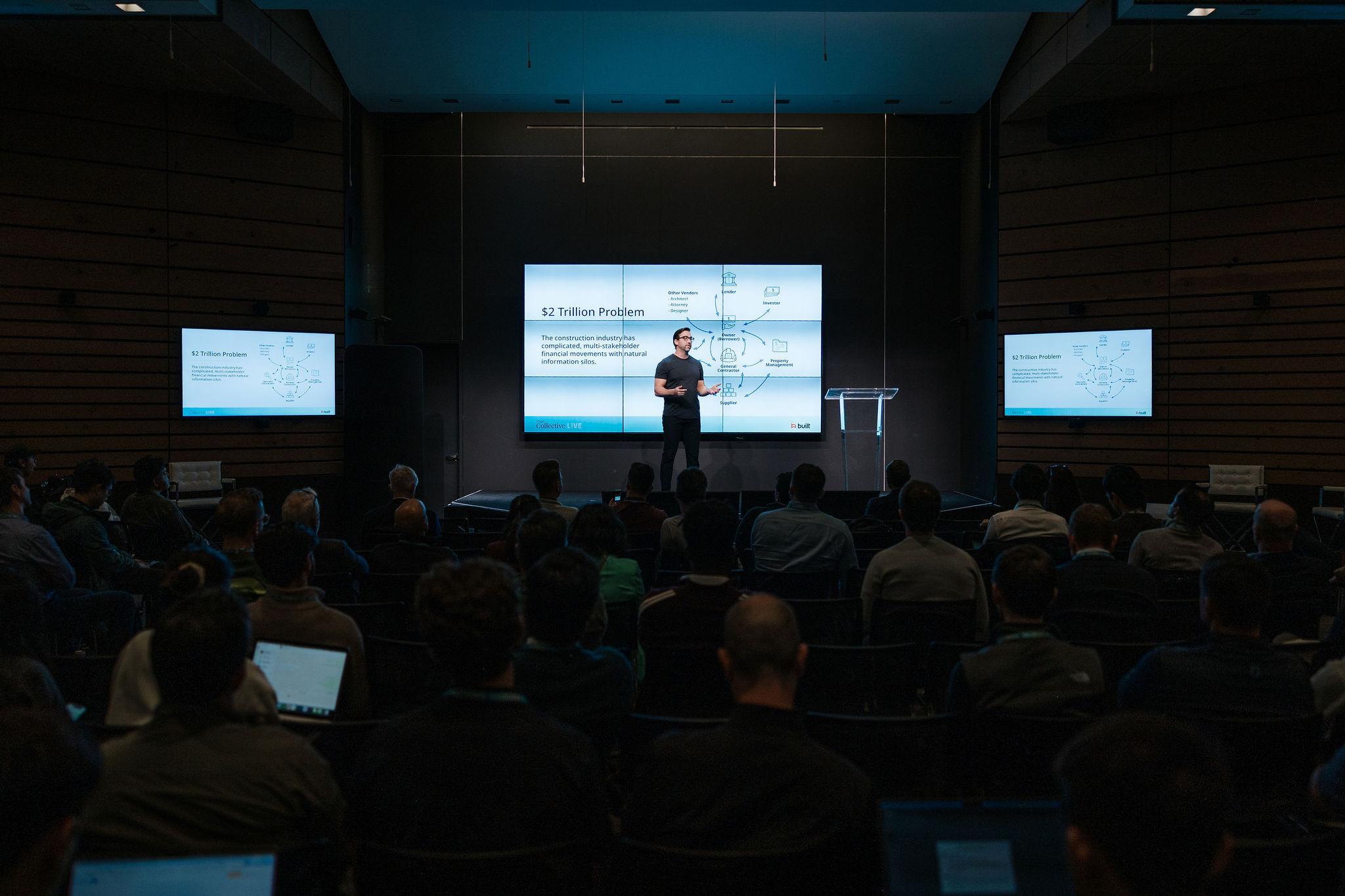
He rewound to 2014, when Built was just taking shape. His co-founders were developers; he was the “tech guy.” And no matter where they looked in construction, they hit the same wall: money and information moved through a long, fragile chain and every step lived in spreadsheets, PDFs, emails, and paper checks. The further downstream you were, the more cash-flow risk you carried. You couldn’t fix that by giving one persona better software. You had to give everyone the same source of truth.
The insight that unlocked the strategy was simple but structural: in construction, debt is the Control Point. Lenders write the checks and set the rules. Every contract downstream mirrors the loan agreement. So Built didn’t start with contractors or owners. It started with the stakeholder that had the leverage — lenders — and gave them a real System of Action for managing budgets and draws that had previously been tracked in Excel and inboxes. The “industry ledger” label didn’t come from branding. It came from the reality that this was the only part of the ecosystem powerful enough to change how funds moved.
From there, the rollout was deliberately slow and sequential. Built spent eight years on lenders before adding an owner hub, then a GC hub — all sitting on a data model designed from day one for nested budgets (lender <> owner <> GC <> subs) and dual ledgers that stay consistent while exposing only the right level of detail to each party. Subcontractors and suppliers are explicitly next. Gilbert had them greyed out on his slide to make the point: they’re not boxes the company pretends it already solved.
That patience shows up in the numbers. As of 2025, Built now works with around 300 financial institutions — roughly three-quarters banks, one-quarter private credit — touching more than $300B in active real-estate AUM and about 145,000 owners and contractors. Gilbert’s framing was straightforward: the network is the scarce resource. First you earn volume and relationships; take rate and product expansion come later.
He also spent time on go-to-market and org design. You don’t “turn on” an industry ledger with PLG. You earn it. Each stakeholder group is treated like its own business: direct sales, deep banking and construction expertise, and product teams that could stand alone. Only after a segment works do they add embedded distribution or in-product upgrades. (“We hope you liked getting your money faster. …Did you know we have a product you could run your business on?”) Core platform services repeat; customer understanding doesn’t.
Gilbert closed by tying all of this to the AI moment. Vertical SaaS already sits closer to the domain and the data than horizontal tools. But once you become the system where multiple stakeholders run their actual budgets, inspections, payments, and draw workflows — the real system of record and of action — you’re much harder to disintermediate with a generic model. Built is now adding agents to each stakeholder experience, with the advantage that those agents can talk to each other on top of a unified ledger only Built controls.
His takeaway for founders was direct: workflows create value, but coordination is the moat. If you become the shared truth in a spreadsheet-ridden, multi-party value chain like construction, you’re not just modernizing a workflow. You’re taking ownership of where money, risk, and decisions actually move.
For more on Industry Ledgers, explore our deep dive here.

Stay in the Loop
Enter your details and be notified when we publish new articles on The Highpoint.